Hiring Tech Talent in South Africa? Here’s when a recruiter is a growth lever and when it’s just burn.
Hiring tech talent in South Africa right now feels a bit like modern dating - You’re either getting ghosted, misled, or everyone good is already taken.
And if you’re a CTO or founder, you don’t have time to scroll LinkedIn like it’s Tinder.
One minute you’re shipping product, next minute, you’re reviewing CVs from someone whose last commit was in 2012.
It’s noisy. It’s slow. And it’s pulling you away from the one thing you should be doing - Building.
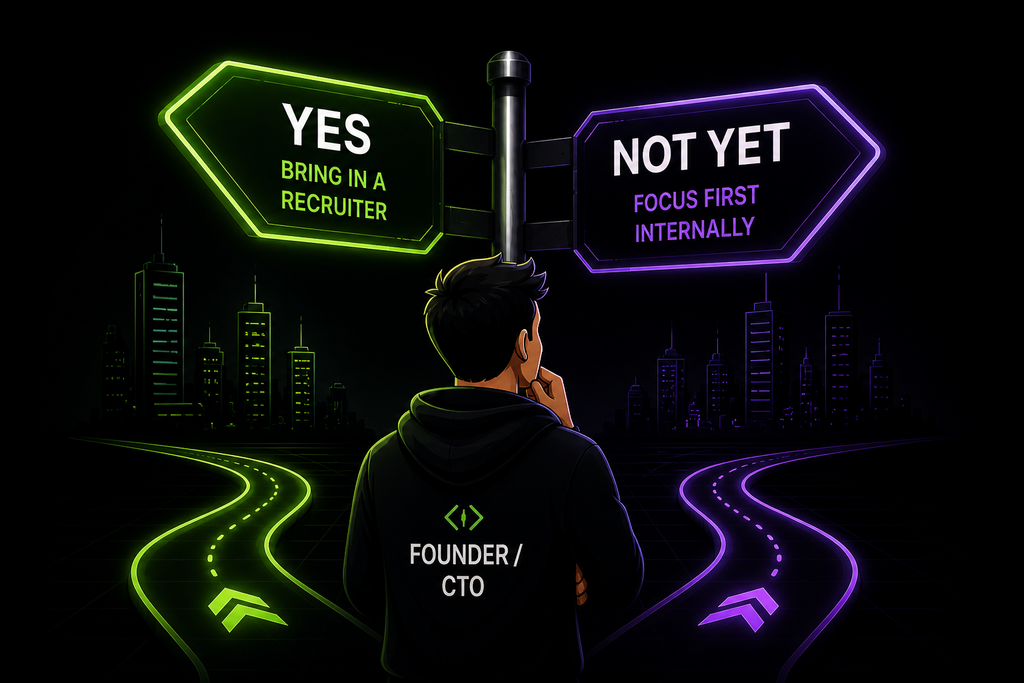
So the question comes up: Do we bring in a recruiter or push through ourselves?
The honest answer is simple. It depends on what problem you’re actually trying to solve.
When a recruiter is a force multiplier
1. You are hiring for roles that do not exist on job boards
AI Product Engineers, Senior Engineers. Strong Data Engineers. DevOps-heavy full stack profiles. These people are not applying.
OfferZen data shows that over 50 percent of South African developers are not actively job hunting. They move when approached with the right opportunity.
If your strategy is to post and pray, you are not even in the market.
A good recruiter changes that by:
• Accessing passive talent
• Knowing who is quietly open
• Positioning your opportunity in a way that actually lands
2. Your hiring process is slowing down your roadmap
Average time to hire for tech roles in South Africa sits between 60 and 90 days.
That is not just a hiring metric. That is lost product velocity.
• Features get delayed
• Sprints stretch out
• Team morale drops
A strong recruiter does more than send CVs. They:
•Pre-qualify candidates properly
• Align expectations before interviews
• Remove friction from your process
The result is shortlists that convert, not inbox clutter.
3. You do not have a hiring engine, you have a bottleneck
Most startups do not have a real hiring process.
They have:
• A Notion doc
• A job spec written late at night
• A founder juggling interviews between everything else
Hiring becomes reactive and reactive hiring is slow, inconsistent, and expensive.
A recruiter becomes:
• Your sourcing engine
• Your screening layer
• Your candidate experience
Without the cost of building an internal team too early.
4. You are competing globally, whether you realise it or not
You are not just competing with local startups anymore.
You are competing with:
• Remote-first US startups paying in dollars
• European companies offering relocation
• South African corporates offering large sign-on bonuses
At the same time, 73 percent of South African developers say meaningful work matters more than brand name - That is your advantage. But only if someone can communicate it properly. A job spec will not do that. A recruiter who understands your business will.
When a recruiter is the wrong move
1. You are hiring juniors
The junior market in South Africa is still oversupplied. You will get inbound applications.
A recruiter here adds cost, not leverage.
2. You are not clear on the role yet
If you are still asking: Do we actually need this role or what should this person be responsible for? You are not ready.
Bringing in a recruiter at this stage creates noise and misalignment.
3. Your internal hiring function is already working
If you have a strong talent lead who:
• Delivers consistently
• Moves quickly
• Understands your tech
Let them run.
External support only makes sense when:
• You hit capacity
• You need niche roles
• Or your hiring speed starts slipping
TLDR;
Hiring in South Africa is not broken. It is bottlenecked. The talent is there and the demand is global. The gap is execution.
If you are:
• Losing candidates because of slow processes
• Drowning in low quality CVs
• Spending more time hiring than building
Then a recruiter becomes a growth lever.
If not, keep your budget and build internally.
Final thought
The best hiring outcomes do not come from more CVs.
They come from:
• Better targeting
• Better positioning
• Better filtering
That is the difference between hiring fast and hiring right.